Short
Do you have a raja yoga? Probably, and that is the problem
Plays from YouTube (privacy-enhanced mode) when you press play.
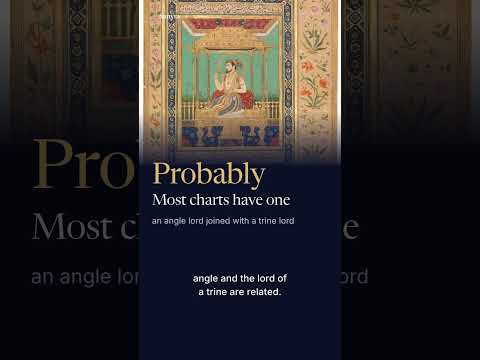
A raja yoga forms when an angle lord and a trine lord are related, and most charts have one. Strength and the dashas decide whether it works.
This video belongs with Raja Yoga in Astrology: The Angle–Trine Rule, Examples and Limits, which has the full explanation and its classical sources.
Why the answer is usually yes
Count the rulers. Every rising sign produces four angular houses (the 1st, 4th, 7th and 10th) and three trinal ones (the 1st, 5th and 9th), and those seats are shared out among only seven classical planets. With so few owners holding so many key houses, the chance that at least one angle ruler and one trine ruler end up together, facing each other across the zodiac, or sitting in each other's signs is high. Run through a few dozen real horoscopes and some version of the royal combination turns up in most of them. Simply having one therefore says very little; how well it is built says almost everything.
The rule, stated exactly
Parashara gives the principle in the raja yoga chapter of his Hora Shastra (ch. 39 in R. Santhanam's translation): a kendra lord and a kona lord must be connected. Three kinds of connection count in full: occupying one sign, mutual aspect, and parivartana, an exchange of signs. Since the ascendant is both the first angle and the first trine, its ruler can pair with any of the others.
Whole-sign houses keep the lordships unambiguous. Take Aries rising: Mars owns the 1st, the Moon the 4th, Venus the 7th and Saturn the 10th, while the Sun holds the 5th and Jupiter the 9th. A Sun and Saturn conjunction links the 5th and 10th rulers and qualifies, yet the two are natural enemies, a first hint that the result will come with friction. Mantreswara's Phaladeepika (ch. 7) adds a long list of further royal combinations, among them the ninth and tenth lords exchanging signs.
One planet doing the work of two
For six ascendants a single planet owns an angle and a trine together and is called the yogakaraka. Saturn has that role for Taurus (9th and 10th) and Libra (4th and 5th); Mars for Cancer (5th and 10th) and Leo (4th and 9th); Venus for Capricorn (5th and 10th) and Aquarius (4th and 9th). It needs no partner. Dignified and well housed, it is already a working combination; debilitated in a hidden house, the title means little.
The best-loved pairing is the ninth ruler joined with the tenth, dharma karmadhipati yoga: the lord of purpose and fortune linked to the lord of action and career. Tradition prizes it because it aligns a sense of calling with the work a person actually does.
What makes one strong, and what quietly undoes it
Strength can be checked in a few concrete places. Dignity: own sign, exaltation or a friendly sign. Position: the pair sitting in an angle or trine rather than the 6th, 8th or 12th. Freedom from damage: not combust, not hemmed in between malefics, not losing a planetary war. Confirmation in the navamsa, the ninth divisional chart, and a reasonable Shadbala score, the sixfold measure of planetary strength.
Weakening is equally concrete. A planet may rule an angle or trine and also a dusthana; for Gemini rising Saturn holds both the 9th and the 8th, so any yoga it joins carries an eighth-house tone. Debilitation without neecha bhanga, combustion and placement in a difficult house all dilute the outcome. By contrast, the pair in the 10th, dignified and aspected by a strong Jupiter, is the textbook version that does deliver.
Timing, and testing your own chart
A combination waits for its period. It speaks mainly in the Vimshottari mahadashas and antardashas of the planets that make it. Those major periods last from six years (the Sun) to twenty (Venus), so a yoga whose rulers come up at age eight or eighty-five stays largely latent.
To test it yourself: note the rising sign, list who rules the 1st, 4th, 7th, 10th, 5th and 9th, and see whether any angle ruler and trine ruler share a sign, oppose each other, or swap signs. Then record their dignity in the birth chart and navamsa, and find when their dashas fall in your life.
Claims worth questioning
Be cautious with anyone who treats a raja yoga as proof of future greatness, or says a weak one must be activated with an expensive ritual or stone; neither idea comes from Parashara. The texts list hundreds of yogas, most charts hold several pulling in different directions, and none settles a life on its own. The tradition's own claim is modest: it shows where effort is likely to meet favourable circumstances, and roughly when.
Sources: Brihat Parashara Hora Shastra, ch. 39 (raja yogas), tr. R. Santhanam · Phaladeepika of Mantreswara, ch. 7, tr. V. Subrahmanya Sastri · Brihat Parashara Hora Shastra, ch. 46 (Vimshottari dasha), tr. R. Santhanam
Transcript
Do you have a raja yoga, the royal combination? Probably. And that is exactly the problem. A raja yoga forms when the lord of an angle and the lord of a trine are related. Some form of it appears in most charts.
So what matters is not whether you have one. It is how strong the planets are, where they sit, and whether their dashas run in the active years of your life. A raja yoga is a potential for rise, not a guarantee. Check your raja yogas with a free kundli at sunyra.ai.
Astrology is a tradition of interpretation; read this as guidance, not a forecast. Disclaimer.