
On this page
In short: Mercury is the mind that names, connects and exchanges: speech, writing, learning, trade, humour and skill with the hands. In Vedic astrology Budha is the prince of the planetary court, a youthful, adaptable planet that takes on the colour of whatever it is joined with. In Western astrology Mercury is the messenger — how you think, speak and learn. Its Vimshottari dasha lasts seventeen years.
At a glance
| Vedic (sidereal) | Western (tropical) | |
|---|---|---|
| Names | Budha, Saumya, Rauhineya, Chandraputra | Mercury, Hermes |
| Rules | Mithuna (Gemini), Kanya (Virgo) | Gemini, Virgo |
| Exaltation | Kanya (Virgo), deepest at 15° | Virgo (15°) |
| Debilitation / fall | Meena (Pisces), deepest at 15° | Pisces |
| Moolatrikona | Virgo 15°–20° (BPHS) | — |
| Detriment | — | Sagittarius, Pisces |
| Nakshatras ruled | Ashlesha, Jyeshtha, Revati | — |
| Vimshottari dasha | 17 years | — |
| Day | Wednesday (Budhavara) | Wednesday (Mercredi, Miércoles) |
| Natural friends (BPHS) | Sun, Venus | — |
| Natural enemy (BPHS) | Moon (Mars, Jupiter, Saturn neutral) | — |
| Gem / colour (traditional) | Emerald; green | — |
Mercury is unusual in rising to exaltation in one of its own signs: Virgo is its exaltation, moolatrikona and own sign in turn, degree by degree.
The story of Budha
Budha's birth is one of the most human stories in the Puranas. The Vishnu Purana (4.6) and Bhagavata Purana (9.14) tell how Chandra, the Moon, carried off Tara, the wife of Brihaspati, the teacher of the gods. Brihaspati demanded her return; Chandra refused; the gods and the demons took sides, and a war followed until Brahma made peace and Tara was restored. But she was with child. The boy was born so beautiful and so luminous that both Brihaspati and Chandra claimed him. Tara, ashamed, would not speak — until the child himself demanded to know his father. Then she said he was Chandra's. Brahma named the boy Budha, "the wise one", for his intelligence.
The story leaves its mark on the astrology. Budha is called Saumya, son of Soma, and Rauhineya, of Rohini's line. And Parashari astrology preserves an asymmetry: the Moon counts Mercury as a friend, but Mercury counts the Moon as an enemy (BPHS ch. 3), a son who never quite forgave the circumstances of his birth.
Budha later married Ila, the daughter (in some tellings, the transformed son) of Vaivasvata Manu. Their son Pururavas became the first king of the Lunar Dynasty (Chandravamsha), the line from which the Yadavas, the Kauravas and the Pandavas descend (Vishnu Purana 4.1; Bhagavata Purana 9.1). BPHS ch. 2 associates Mercury with the Buddha avatara of Vishnu, and the classical lists of planetary deities give Mercury to Vishnu himself.
The Greek Hermes is a cousin in temperament. The Homeric Hymn to Hermes tells how, on the day he was born in a cave on Mount Cyllene, Hermes invented the lyre from a tortoise shell, then stole fifty of Apollo's cattle and drove them backwards so their tracks would point the wrong way — a story astrologers enjoy, given Mercury's famous retrogrades. He talked his way out of trouble and became the messenger of the gods, guide of souls, and patron of travellers, merchants, and thieves. The Roman Mercury, whose name is linked with merx, merchandise, was above all the god of trade.
The real Mercury
Mercury is the smallest planet in the solar system (4,879 km across) and the closest to the Sun, at an average of about 58 million km (0.39 AU). It goes round the Sun in 88 days, faster than any other planet. It spins slowly — once every 59 Earth days — and in a 3:2 resonance with its orbit, so one full day-night cycle on Mercury lasts 176 Earth days. It has no moons and almost no atmosphere; temperatures swing from around 430 °C by day to about −180 °C by night.
From Earth, Mercury never strays more than about 28° from the Sun, so it is always in the same sign as the Sun or in the sign on either side. It appears retrograde three times in most years (occasionally four), each time for about three weeks.
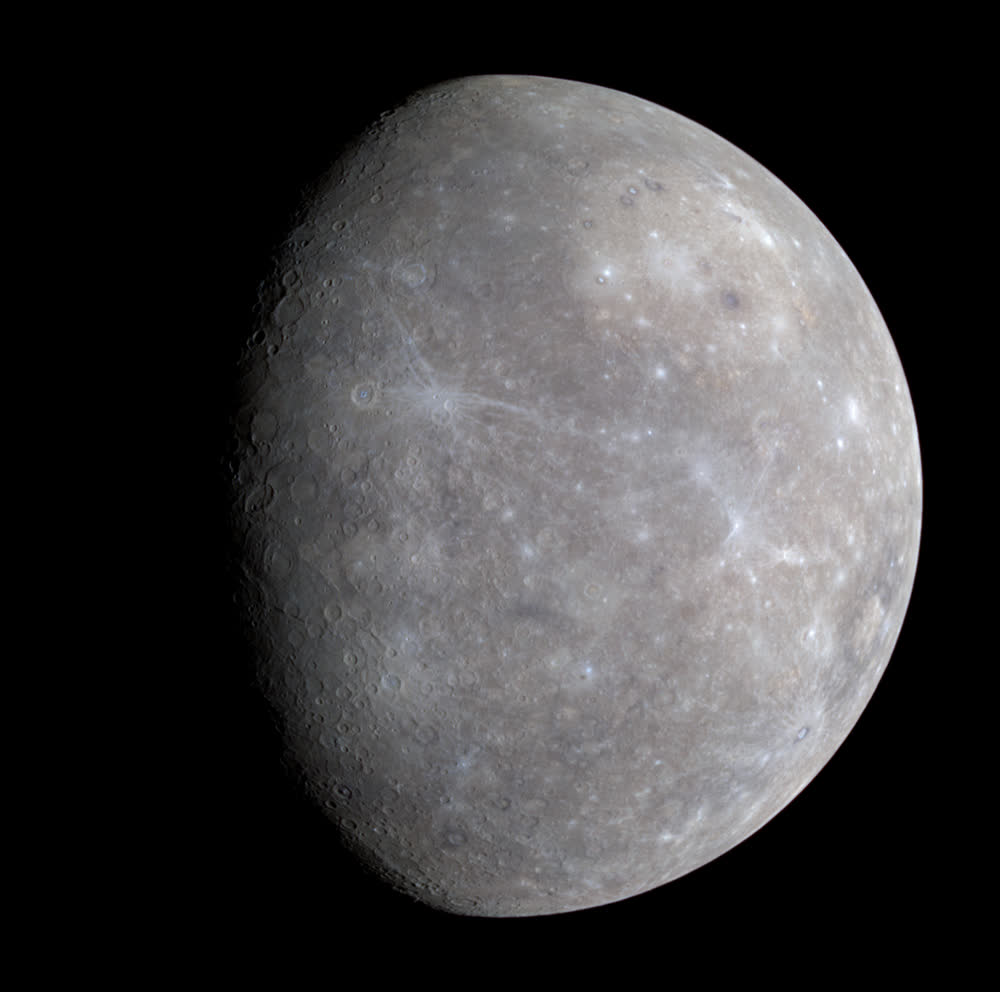
- The fastest planet. Closest to the Sun at an average 57.9 million km, Mercury goes round it in 88 days at about 47 km a second.
- Quick year, slow day. It turns so slowly that one sunrise-to-sunrise day lasts 176 Earth days, two of its years.
- Everyone's nearest neighbour. Averaged over time, Mercury, not Venus, is the planet closest to Earth, and to every other planet as well, because it never strays far from the Sun at the centre (Stockman, Monroe and Cordner, Physics Today, 2019).
- Not the hottest planet (Venus is). With almost no air to hold heat, Mercury swings from about 430 °C by day to about −180 °C at night.
What the tradition saw
Budha is the messenger: speech, trade, learning, numbers, the quick mind that connects one person to another. The real Mercury is the fastest traveller of the planets and, on average, the nearest to all of them: a natural go-between. Its slow day is a quieter lesson. Messages move fast, but understanding takes its own time.
What Mercury means
In Vedic astrology
In the cosmic person of Brihat Jataka 2.1 and BPHS ch. 3, Mercury is speech (vak), and in the planetary court it is the prince. Its significations include:
- Intelligence and learning — analysis, discrimination (buddhi), mathematics, writing, languages, memory for detail.
- Speech and communication — eloquence, wit, humour, mediation.
- Trade and commerce — accounts, negotiation, business sense.
- Youthfulness — Mercury is the eternal adolescent of the grahas, playful and quick.
- Relatives — classical texts name Mercury as significator of the maternal uncle, and of friends and peers.
- Body associations — the skin, the nervous system and speech, as classical associations rather than medical claims.
- Nature — rajasic, counted neither male nor female (napumsaka) in BPHS, earthy in element. Strong in the 1st house (directional strength, shared with Jupiter).
Mercury is a natural benefic, but classical texts make it conditional: Mercury alone or with benefics is benefic; joined with malefics it becomes malefic. It is the most impressionable of the planets, and astrologers read it through its companions more than any other.
In Western astrology
Ptolemy (Tetrabiblos I.4) describes Mercury as changeable: at times drying, at times moistening, and quick to change from one to the other, because it is always close to the Sun and near the Moon's sphere. Hellenistic astrologers treated Mercury as belonging to either sect — diurnal when it rises before the Sun as a morning star, nocturnal when it sets after the Sun as an evening star. Lilly (Christian Astrology, Book I, chapter on Mercury) describes a well-placed Mercury as a person "of a subtle and politic brain", eloquent and studious, and an afflicted one as "a great liar, boaster, prattler, busybody" — the two faces of the same gift.
Modern Western astrology reads Mercury as the style of the mind: how you think, learn, speak and write, how you process information, and how you move through your local world of siblings, neighbours, errands and messages.
Mercury retrograde
Three or four times a year, Mercury appears to move backwards against the stars for about three weeks. In popular Western astrology these periods are associated with miscommunications, delays and technology glitches, and the traditional advice is to review, revise and reconnect rather than launch. Vedic astrology treats a retrograde planet (vakri) differently: classical texts associate retrograde planets with strength (cheshta bala, motional strength), because a planet is retrograde when it is closest to Earth and brightest. Both traditions agree that a natal retrograde Mercury is not a flaw; it often describes a reflective, idiosyncratic or late-blooming mind.
Strengths
A good Mercury gives a lively, flexible intelligence: quick learning, clear expression, a sense of humour, curiosity, and the ability to see more than one side. It is the planet of the good teacher, the careful editor, the deft negotiator, and the person who can explain anything.
Challenges
The same agility can scatter. A strained Mercury may show as nervous overthinking, restless attention, difficulty committing to one view, or speech that runs ahead of judgement. Debilitated in Pisces, Mercury's logic is softened by imagination, a trade that can make for poets and dreamers but also for muddled detail. Mercury combust — very close to the Sun, as it often is — is traditionally said to tie thinking to the ego, though many authorities consider Mercury less harmed by combustion than other planets because it is so often there.
In relationships
Mercury shows how you talk to the people you love. In Western synastry, Mercury contacts suggest easy conversation and shared humour. In Vedic astrology a strong Mercury in or aspecting the 7th house gives a youthful, communicative partnership. For many people, the honest test of a relationship is Mercurial: can we talk about anything?
In career and work
Mercury rules the professions of words, numbers and exchange: writing and publishing, teaching, accounting and finance, commerce and sales, software and analysis, translation, journalism, law (with Jupiter), and any trade that depends on precise detail. A Mercury connected with the 10th house often points to a career built on skill and communication.
Health as wellbeing
Traditionally Mercury is linked with the nervous system, the skin and the breath. As wellbeing, Mercury asks for mental rest: fewer tabs open, more walks, good sleep, and conversation that nourishes rather than drains. These are traditional associations, not medical guidance.
How Mercury changes by placement
- By sign. Exalted in Virgo, Mercury is precise, practical and analytical. In Gemini it is curious and social. Debilitated in Pisces, it thinks in images and feelings more than lists. In fire signs it speaks quickly; in water signs it remembers emotionally.
- By house. In the 1st house it has directional strength and gives a youthful, articulate presence. In the 10th it favours careers of skill. In the 2nd it can give a gift for speech or finance.
- By aspect and conjunction. Sun with Mercury forms Budha-Aditya yoga, traditionally associated with intelligence and good judgement (very common, so astrologers look at the degree of separation and dignity). Mercury in a kendra in its own or exaltation sign forms Bhadra yoga, one of the five Pancha Mahapurusha yogas. Mercury with Saturn deepens and slows the mind; with Mars it sharpens argument.
- By nakshatra. Mercury's nakshatras — Ashlesha, Jyeshtha and Revati — are each the last nakshatra of a water sign (Cancer, Scorpio, Pisces). These junction points (gandanta) are considered sensitive, where intelligence meets deep feeling.
The Mercury dasha (Vimshottari)
The Mercury mahadasha lasts seventeen years. It follows Saturn's nineteen years and precedes Ketu's seven. Those born with the Moon in Ashlesha, Jyeshtha or Revati begin life in Mercury's dasha — fitting, as the period often coincides with childhood and education. In adult life, Mercury periods often emphasise study, writing, trade, travel, networks and skill-building. How it unfolds depends on Mercury's dignity, its companions and the houses it rules.
Vedic and Western views compared
The traditions agree on almost everything: Mercury rules Gemini and Virgo, is exalted in Virgo, falls in Pisces, and signifies intelligence, speech and trade. The main difference is retrograde: popular Western astrology treats it as a time of glitches; classical Vedic astrology treats a retrograde planet as strong. Vedic astrology also stresses Mercury's dependence on its companions more explicitly.
Traditional remedies
For Mercury the tradition suggests worship of Vishnu (the Vishnu Sahasranama is often recommended), charity of green gram (moong dal) or green cloth on Wednesdays, feeding birds or cows, and — as the most practical remedy — cultivating truthful, careful speech and steady study. Emerald is the traditional gem, recommended only after a full chart reading. These are traditional practices, not guarantees.
FAQ
Is Mercury retrograde bad? Popular Western astrology treats it as a time for review rather than launches. Classical Vedic astrology considers retrograde planets strong. It is best read as a natural pause, not a threat.
Why is Mercury always near my Sun sign? Because Mercury never moves more than about 28° from the Sun as seen from Earth.
Is Mercury a benefic? Yes, conditionally: benefic alone or with benefics, malefic when joined with malefics.
How long is the Mercury dasha? Seventeen years in the Vimshottari system.
What is Budha-Aditya yoga? The conjunction of the Sun and Mercury, traditionally linked with intelligence. It is very common, so its strength depends on degrees and dignity.
Sources
- Brihat Parashara Hora Shastra, ch. 2–3 (Santhanam)
- Brihat Jataka of Varahamihira, ch. 2
- Phaladeepika of Mantreswara, ch. 2
- Vishnu Purana 4.1, 4.6; Bhagavata Purana 9.1, 9.14
- Homeric Hymn to Hermes
- Ptolemy, Tetrabiblos I.4, I.17, I.19
- William Lilly, Christian Astrology (1647), Book I
- D. R. Williams, NASA NSSDCA Mercury Fact Sheet, 2025
- T. Stockman, G. Monroe, S. Cordner, Venus is not Earth's closest neighbor, Physics Today, 2019
- Images: NASA (via Wikimedia Commons), public domain
Written by Sunyra Editorial. Astrology is a tradition of interpretation; read this as guidance, not a forecast. Disclaimer.
Last reviewed