
On this page
In short: Jupiter is the great benefic of both traditions: wisdom, faith, generosity, teachers, children, good fortune and the sense that life has meaning. In Vedic astrology it is Brihaspati, the guru of the gods, and its aspect is the single most protective influence in a chart. In Western astrology it is the planet of growth and opportunity. Jupiter's gifts are real, but so is its one temptation: too much. Its Vimshottari dasha lasts sixteen years.
At a glance
| Vedic (sidereal) | Western (tropical) | |
|---|---|---|
| Names | Guru, Brihaspati, Deva-guru, Jiva, Suri | Jupiter, Jove, Zeus |
| Rules | Dhanu (Sagittarius), Meena (Pisces) | Sagittarius; Pisces (traditional) |
| Exaltation | Karka (Cancer), deepest at 5° | Cancer (15° in the medieval tradition) |
| Debilitation / fall | Makara (Capricorn), deepest at 5° | Capricorn |
| Moolatrikona | Sagittarius 0°–10° | — |
| Detriment | — | Gemini, Virgo |
| Special aspects | 5th and 9th from itself (plus the 7th) | — |
| Nakshatras ruled | Punarvasu, Vishakha, Purva Bhadrapada | — |
| Vimshottari dasha | 16 years | — |
| Day | Thursday (Guruvara, Brihaspativara) | Thursday (Jeudi, Jueves) |
| Natural friends (BPHS) | Sun, Moon, Mars | — |
| Natural enemies (BPHS) | Mercury, Venus (Saturn neutral) | — |
| Gem / colour (traditional) | Yellow sapphire; yellow | — |
The story of Brihaspati
Brihaspati is a Vedic god before he is a planet. His name means "lord of the sacred word" (brih, prayer or sacred speech), and in the Rigveda he is the priest whose chant has power. Rigveda 10.68 and 4.50 tell how, with his song and his companions, he split open the rock of Vala and released the cows that had been hidden inside — usually understood as the dawns, or light itself, set free by sacred speech. From the beginning, then, Jupiter is the power of the right word spoken at the right time.
In the epics and Puranas, Brihaspati is the son of the sage Angiras and the purohita — family priest and counsellor — of the gods. His rival is Shukra, the teacher of the asuras (see Venus). The most famous story between them is told in the Mahabharata's Adi Parva. Shukra alone knew the Mrita-sanjivani, the knowledge that raises the dead, so the asuras' fallen warriors kept returning to battle. The gods sent Kacha, Brihaspati's son, to become Shukra's student. Shukra's daughter Devayani fell in love with him; the asuras killed Kacha again and again, and each time Devayani persuaded her father to revive him — until the asuras burned his body, mixed the ashes in wine and gave it to Shukra to drink. To save Kacha, Shukra had to teach him the secret while Kacha was still inside him; Kacha then emerged and revived his teacher. The story is about loyalty, learning and the cost of knowledge, and it is the mythic root of the natural enmity between Jupiter and Venus in Parashari astrology.
Brihaspati is also the wronged husband in the story of Tara and Chandra, which produced Mercury (Vishnu Purana 4.6). BPHS ch. 2 associates Jupiter with Vamana, the dwarf avatara of Vishnu who reclaimed the three worlds from King Bali in three strides.
The Roman Jupiter (Greek Zeus) was king of the gods, lord of the sky and thunder, guardian of oaths, law and hospitality. The English word "jovial", from Jove, preserves the old astrological belief that people born under Jupiter are good-humoured and generous.
The real Jupiter
Jupiter is the largest planet: about 143,000 km across at the equator, eleven times Earth's width, with more than twice the mass of all the other planets put together. It orbits at an average of 778 million km (5.2 AU), taking 11.86 years to go round the Sun, and it spins faster than any other planet, once every 9 hours 56 minutes. It is a gas giant, mostly hydrogen and helium, with a storm, the Great Red Spot, that has been watched since at least the 1800s (possibly since the 1600s) and is still wider than Earth though it has been shrinking. Its four large moons — Io, Europa, Ganymede and Callisto — were discovered by Galileo in January 1610; Ganymede is the largest moon in the solar system. Jupiter has dozens of smaller moons as well, and the count keeps rising as surveys find more.
From Earth, Jupiter spends about a year in each sign, completing the zodiac in about twelve years. It goes retrograde once a year for about four months.

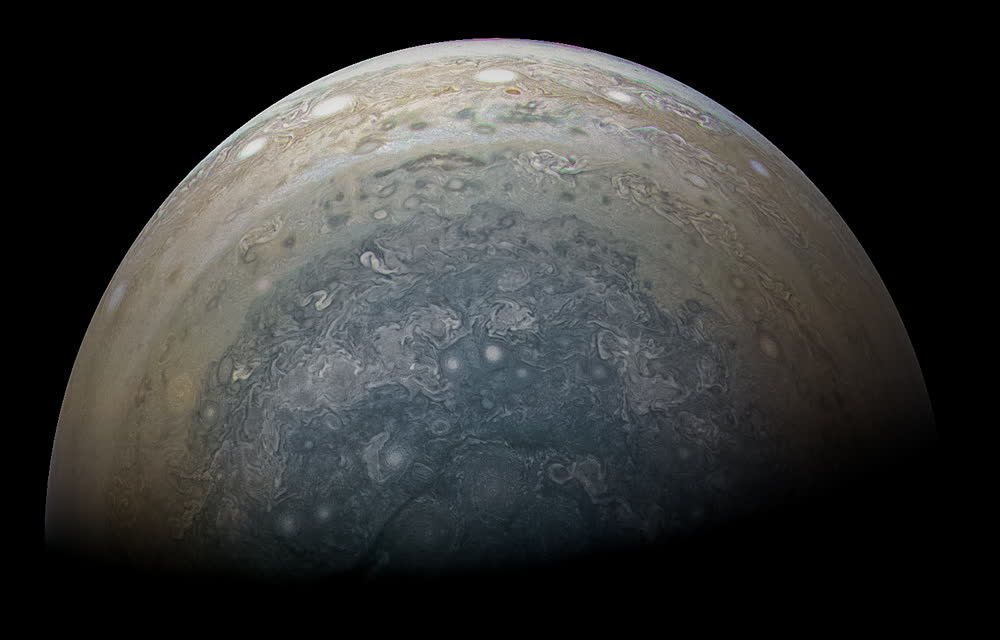
- The giant. Jupiter holds about two and a half times the mass of all the other planets put together (our sum from NASA's fact sheet).
- A protector, with a footnote. Jupiter's gravity flings many long-period comets out of the solar system, and in July 1994 it took the impacts of comet Shoemaker–Levy 9. It is often called Earth's shield. Computer simulations (Horner and Jones, 2008–2009) give a more careful answer: Jupiter also nudges some asteroids and short-period comets toward the inner planets. On balance it is not a simple wall.
- It spins fastest of all the planets: a day of under ten hours.
What the tradition saw
Guru is the teacher, the protector, the planet of growth, wisdom and grace. The real Jupiter is the largest presence in the planetary family, and it does protect, but not by keeping everything away. Some things it sends off; others it sends our way. A real teacher works like that too. Protection is not the same as comfort.
What Jupiter means
In Vedic astrology
In the cosmic person (Brihat Jataka 2.1; BPHS ch. 3) Jupiter is knowledge and happiness (jnana and sukha), and with Venus it is a minister in the planetary court. Its significations include:
- Wisdom and teaching — the guru, religious and philosophical learning, scripture, law and ethics.
- Children — Jupiter is the natural significator of the 5th house.
- Wealth and fortune — significator of the 2nd, 9th and 11th houses: accumulated wealth, blessings and gains.
- The spouse in a woman's chart — a classical association, read today with the whole 7th house and Venus as well.
- Grace — dharma, faith, generosity and protection; the sense of being guided.
- Body associations — the liver, fat and growth, as classical associations rather than medical claims.
- Nature — sattvic, masculine, ethereal (akasha), the greatest natural benefic. Strong in the 1st house (directional strength).
Jupiter's aspect is perhaps its most important feature. Besides the 7th house from itself, it fully aspects the 5th and 9th (BPHS ch. 26), and classical practice treats a Jupiter aspect as protective of whatever it touches — a house, a planet, or a difficult combination.
In Western astrology
Ptolemy (Tetrabiblos I.4) gives Jupiter a temperate, warming and moistening power, and in I.5 names it with Venus (and the Moon) as beneficent. In Hellenistic astrology Jupiter is the benefic of the diurnal sect, at its best in a day chart. Lilly (Christian Astrology, Book I, chapter on Jupiter) paints the well-dignified Jupiter as magnanimous, faithful and just, and the ill-dignified one as wasteful, careless and prone to hypocrisy in religion.
Modern Western astrology reads Jupiter as expansion: growth, optimism, opportunity, travel, higher education, belief and meaning. Its twelve-year cycle marks "Jupiter returns" at about 12, 24, 36, 48, 60 and so on, often remembered as moments of widening horizons.
Strengths
A strong Jupiter gives generosity, good judgement, a hopeful temperament, a love of learning and the ability to inspire trust. It often shows people who become teachers, mentors and counsellors whether or not that is their job title. Jupiter tends to protect: well-placed, it softens hard combinations and brings help when it is needed.
Challenges
Jupiter's challenge is excess: too much optimism, over-commitment, overeating, overspending, moralising or self-righteousness. A debilitated Jupiter (in Capricorn) can make faith hard-won and generosity cautious, or bring teachers who disappoint before wisdom is found. Classical texts also note that Jupiter, as lord of difficult houses for certain ascendants, can carry those houses' themes — benefic nature and functional role are both read.
In relationships
Jupiter brings warmth, loyalty and the wish to grow together. In Western synastry, Jupiter contacts suggest generosity and encouragement between two people. In Vedic astrology, Jupiter's aspect on the 7th house or on Venus is one of the most valued signatures of a stable marriage, and Jupiter is consulted for children through the 5th house. Jupiter's lesson in love is to give without keeping score — and not to lecture.
In career and work
Jupiter favours teaching, academia, law and the judiciary, religion and counselling, finance and banking, publishing, advisory and consulting roles, and leadership grounded in ethics. Jupiter connected to the 10th or 11th house often supports reputation and gains through good counsel.
Health as wellbeing
Traditionally Jupiter governs the liver, fat and growth in the body, and the tendency to excess. As wellbeing, Jupiter asks for moderation in good things, and for meaning: people tend to flourish when they feel their lives are for something. These are traditional associations, not medical guidance.
How Jupiter changes by placement
- By sign. Exalted in Cancer, Jupiter is compassionate and protective, a generous spirit with deep roots. In Sagittarius it is principled and adventurous; in Pisces, devotional and imaginative. Debilitated in Capricorn, its wisdom is practical and its faith is tested by the world.
- By house. Jupiter in a kendra (1st, 4th, 7th, 10th) is traditionally strong and protective; in the 1st it has directional strength. In the 5th or 9th it supports learning and fortune. In the 6th, 8th or 12th its generosity often turns toward healing, research or spiritual life.
- By aspect and conjunction. Jupiter in a kendra from the Moon forms Gajakesari yoga. Jupiter in a kendra in its own or exaltation sign forms Hamsa yoga, one of the five Pancha Mahapurusha yogas. Jupiter with Rahu (Guru-Chandala yoga) is read as unorthodox belief or a teacher-student tension, weighed carefully.
- By nakshatra. Jupiter's nakshatras — Punarvasu (return and renewal), Vishakha (single-minded purpose) and Purva Bhadrapada (fierce idealism) — give three faces of the teacher.
The Jupiter dasha (Vimshottari)
The Jupiter mahadasha lasts sixteen years. It follows Rahu's eighteen years and precedes Saturn's nineteen. Those born with the Moon in Punarvasu, Vishakha or Purva Bhadrapada begin life in Jupiter's dasha. Jupiter periods often bring study, teachers, children, marriage, travel, growth in wealth or standing, and deepening faith. A well-placed Jupiter can make it one of the most expansive chapters of a life; a strained Jupiter may bring the same themes with lessons about overreach.
Jupiter's transits matter in both traditions. In Vedic practice its yearly movement through the signs counted from the natal Moon is a staple of forecasting, and Jupiter's position decides the timing of the great Kumbh Mela gatherings — for example, the Prayagraj Kumbh is held when Jupiter is in sidereal Taurus and the Sun in Capricorn. The Indian sixty-year cycle of named years (samvatsara) is traditionally reckoned from Jupiter's motion as well.
Vedic and Western views compared
The traditions agree that Jupiter is the greater benefic: wisdom, growth, generosity, rulership of Sagittarius and (traditionally) Pisces, exaltation in Cancer and fall in Capricorn. Vedic astrology adds the 5th and 9th aspects, the dasha, and Jupiter's role as significator of children, wealth and the husband. Modern Western astrology gives Pisces to Neptune and keeps Jupiter as its traditional ruler, and tends to stress Jupiter's capacity for excess more than classical Vedic texts do.
Traditional remedies
For Jupiter the tradition recommends honouring teachers and elders, charity to students and scholars, offering yellow items (chana dal, turmeric, bananas) on Thursdays, worship of Vishnu or Dakshinamurti, and recitation of the Brihaspati mantra. Yellow sapphire is the traditional gem, recommended only after a full chart reading. These are traditional practices, not guarantees.
FAQ
Is Jupiter always good? It is the greatest natural benefic, but its results depend on dignity, house and which houses it rules. Even Jupiter can bring excess.
What are Jupiter's special aspects? In Parashari astrology, the 5th and 9th houses from itself, as well as the 7th.
How long does Jupiter stay in a sign? About a year, completing the zodiac in about twelve years.
How long is the Jupiter dasha? Sixteen years in the Vimshottari system.
Why are Jupiter and Venus enemies in Vedic astrology? They are the teachers of the gods and the asuras respectively. The Kacha story in the Mahabharata dramatises the rivalry.
Sources
- Brihat Parashara Hora Shastra, ch. 2–3, ch. 26 (Santhanam)
- Brihat Jataka of Varahamihira, ch. 2
- Phaladeepika of Mantreswara, ch. 2
- Rigveda 4.50, 10.68 (Brihaspati)
- Mahabharata, Adi Parva (Kacha and Devayani)
- Vishnu Purana 4.6
- Ptolemy, Tetrabiblos I.4, I.5, I.17, I.19
- William Lilly, Christian Astrology (1647), Book I
- D. R. Williams, NASA NSSDCA Jupiter Fact Sheet, 2025
- J. Horner, B. W. Jones, Jupiter, friend or foe? I: the asteroids; II: the Centaurs; III: the Oort cloud comets, International Journal of Astrobiology, 2008-2009
- Images: NASA (via Wikimedia Commons), public domain
Written by Sunyra Editorial. Astrology is a tradition of interpretation; read this as guidance, not a forecast. Disclaimer.
Last reviewed