
On this page
In short: In both Vedic and Western astrology the Sun is the self at the centre of the chart — vitality, purpose, the father and figures of authority, and the quiet confidence of knowing who you are. Vedic texts call it the atma, the soul. A strong Sun tends to give steadiness and dignity; a strained Sun can show up as pride, or as a lifelong question about being seen. Its Vimshottari dasha lasts six years.
At a glance
| Vedic (sidereal) | Western (tropical) | |
|---|---|---|
| Names | Surya, Ravi, Aditya, Bhanu, Savitr | Sun, Sol, Helios |
| Rules | Simha (Leo) | Leo |
| Exaltation | Mesha (Aries), deepest at 10° | Aries (19° in the medieval tradition) |
| Debilitation / fall | Tula (Libra), deepest at 10° | Libra |
| Moolatrikona | Leo 0°–20° | — |
| Detriment | — | Aquarius |
| Nakshatras ruled | Krittika, Uttara Phalguni, Uttara Ashadha | — |
| Vimshottari dasha | 6 years | — |
| Day | Sunday (Ravivara) | Sunday |
| Natural friends (BPHS) | Moon, Mars, Jupiter | — |
| Natural enemies (BPHS) | Venus, Saturn (Mercury neutral) | — |
| Gem / colour (traditional) | Ruby; copper-red | Gold |
The story of Surya
Surya is one of the oldest gods in the Indian tradition. In the Rigveda he is the eye of the gods and the one who sees everything below; the hymn to Savitr at Rigveda 1.35 imagines him driving his golden chariot across the sky "on the dark path", looking down on all beings. The most repeated verse in the whole Vedic corpus, the Gayatri mantra (Rigveda 3.62.10), is addressed to Savitr, the Sun as the one who rouses and inspires.
In the Puranas, Surya is Vivasvan, one of the twelve Adityas — the sons of the sage Kashyapa and of Aditi, the mother of the gods. His most important story is the story of his marriage, told in the Vishnu Purana (3.2) and at greater length in the Markandeya Purana. Surya married Samjna (also written Sanjna), the daughter of Vishvakarma, the architect of the gods. Samjna bore him three children: Vaivasvata Manu, the progenitor of the present age of humanity, and the twins Yama and Yami (Yamuna). But she could not bear his blazing heat. She created a woman from her own shadow, Chhaya, left her in her place, and went to the forest in the form of a mare to practise austerity.
Chhaya bore Surya three more children, among them Shani (Saturn) and Savarni Manu. When Chhaya showed favour to her own children over Samjna's, Yama protested, and the truth came out. Surya went in search of Samjna, found her as a mare, and joined her in the form of a horse; from that union the twin physicians of the gods, the Ashvins, were born. To make the reunion possible, Vishvakarma placed Surya on his lathe and trimmed away an eighth part of his brilliance. From the shavings, the Vishnu Purana says, he fashioned the discus of Vishnu, the trident of Shiva and other weapons of the gods.
The story is worth knowing because astrologers still read it. It explains why the Sun and Saturn are natural enemies in Parashari astrology — a father and a son born of a shadow — and why Yama, lord of death and dharma, is the Sun's son. It also carries a gentle psychological truth: pure brilliance is hard to live with, and even the Sun had to soften to be loved.
Other well-known threads: in the Mahabharata (Adi Parva) Surya is the father of Karna, born to Kunti before her marriage; in the Valmiki Ramayana (Yuddha Kanda) the sage Agastya teaches Rama the Aditya Hridayam, a hymn to the Sun, before the final battle. His chariot has seven horses and is driven by Aruna, the dawn, elder brother of Garuda. BPHS ch. 2 names Rama as the avatara of Vishnu associated with the Sun.
The real Sun
The Sun is a G-type main-sequence star (G2V), about 4.6 billion years old. It holds roughly 99.8% of the mass of the solar system. Its diameter is about 1.39 million km — some 109 Earths across — and its visible surface is about 5,500 °C (around 5,770 K). Light from the Sun reaches Earth in about 8 minutes 19 seconds on average (often rounded to 8 minutes 20 seconds) across an average distance of 149.6 million km, the distance that defines one astronomical unit.
From Earth, the Sun appears to move about one degree a day along the ecliptic, completing the circle of the zodiac in one year. It never appears retrograde. In the tropical zodiac it enters Aries at the March equinox, around 20–21 March. In the sidereal zodiac used by Vedic astrology (Lahiri ayanamsa), the same entry — Mesha Sankranti — currently falls around 13–14 April, because the sidereal zodiac is fixed to the stars and the equinoxes have drifted about 24° against them through precession.
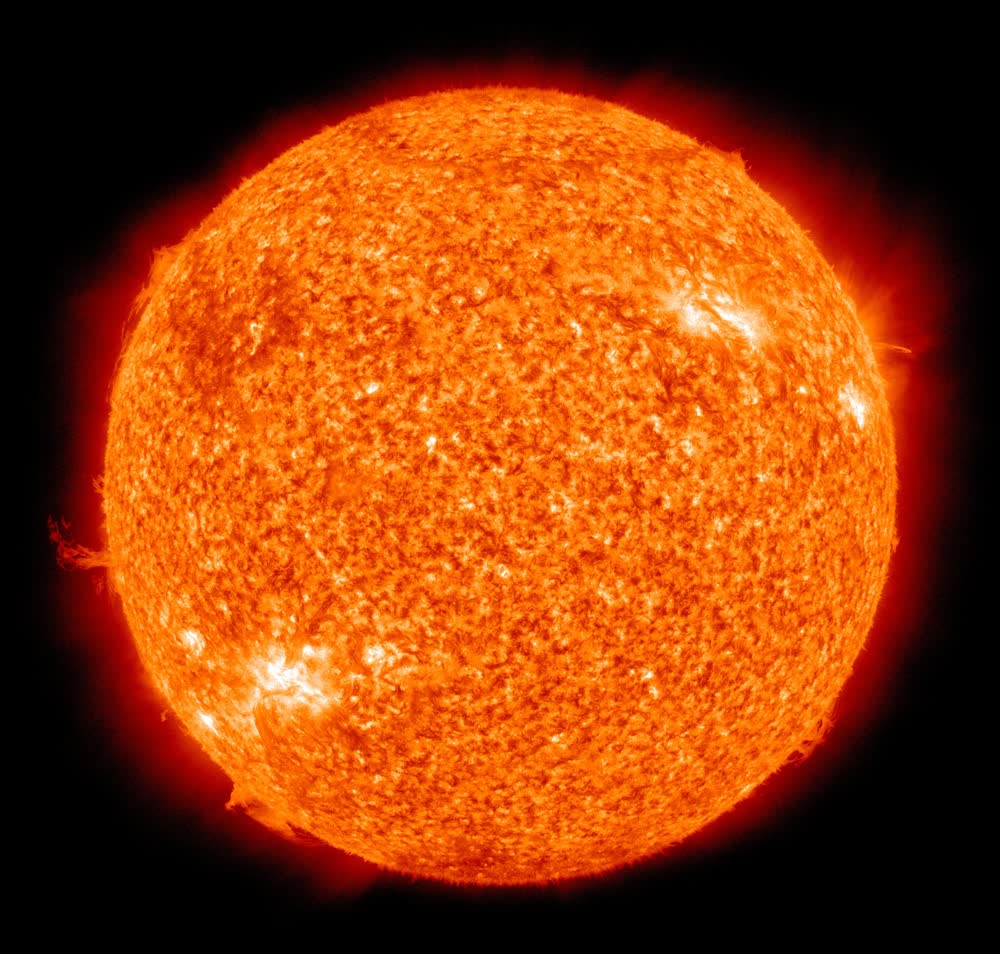
- It gives by spending itself. Every second the Sun turns about 4.3 million tonnes of its own mass into light and heat: NASA's fact sheet gives a mass conversion rate of 4,260 million kg a second. This is E = mc² at work in a core of about 15 million °C.
- It also breathes out. The solar wind carries off roughly another million tonnes or so each second (published estimates vary).
- It is so vast that this barely shows. In 4.6 billion years the Sun has lost well under a tenth of one percent of its mass (our arithmetic from NASA's rate).
- Its light is eight minutes old. Sunlight takes about 8 minutes 19 seconds to reach us on average: about 8 min 11 s in early January, when Earth is closest, and about 8 min 27 s in early July.
What the tradition saw
Surya is the ātman, the soul; the father, the king, the giver of life and sight. The physical Sun gives in exactly that way: by spending itself. Every moment of warmth that reaches us is mass the Sun will never get back, and it goes on giving at the same steady rate whoever is watching. That is the Sun's dignity at its best: generous, constant and unhurried, giving light without asking for it to be returned.
What the Sun means
In Vedic astrology
Varahamihira opens his chapter on the planets (Brihat Jataka 2.1) with the famous image of the "cosmic person": the Sun is the soul (atma), the Moon the mind, Mars strength, Mercury speech, Jupiter knowledge and happiness, Venus desire, and Saturn sorrow. BPHS ch. 3 gives the same list. In the same verse the Sun and Moon are the kings of the planetary court.
From that root grow the Sun's significations, gathered across BPHS ch. 3, Phaladeepika ch. 2 and Brihat Jataka ch. 2:
- The self and its vitality — constitution, stamina, the sense of being alive and allowed to exist.
- The father, and by extension elders, government, rulers, employers and anyone whose authority we live under.
- Dharma and reputation — the Sun is a natural significator (karaka) of the 1st, 9th and 10th houses: the body, fortune and the father, and public standing.
- Body associations — the bones, the heart and the eyes (the right eye in particular), as classical associations rather than medical claims.
- Nature — sattvic in quality, masculine, fiery, a natural malefic in the mild sense that its heat dries and separates. It is strong in the 10th house (digbala, directional strength) and in the northern course of the year.
The Sun "combusts" planets that come too close to it: their significations are said to be absorbed into the ego, or harder to express independently. Classical orbs vary by planet and by text, roughly 12°–17°.
In Western astrology
Ptolemy (Tetrabiblos I.4) describes the Sun's active power as heating and, moderately, drying. In the Hellenistic and medieval tradition the Sun is the leader of the diurnal sect: in a day chart (Sun above the horizon) the Sun, Jupiter and Saturn are "in sect" and generally better placed. William Lilly in Christian Astrology (1647, Book I, chapter on the Sun) describes the well-placed Sun as faithful, magnanimous and humane, a keeper of promises, and the afflicted Sun as arrogant, restless and troublesome — a balanced pair that modern astrologers still recognise.
Modern Western astrology, shaped by Dane Rudhyar and Liz Greene among others, treats the Sun as the core of identity and the path of individuation: what you are becoming, and what makes you feel most yourself. This is why Western popular astrology is organised around the "Sun sign".
Strengths
A well-placed Sun tends to give a clear spine: the ability to make decisions, take responsibility and stand behind your choices. People with a dignified Sun are often generous leaders who do not need to dominate a room to be felt in it. There is warmth here, a sense of honour, and a natural pull toward work that matters.
Challenges
The Sun's shadow is pride. It can show up as needing to be right, difficulty taking direction, or a sensitivity to criticism that feels out of proportion. When the Sun is weak — debilitated in Libra, hemmed in by difficult aspects, or placed in a dusthana (6th, 8th or 12th house) — the challenge often turns inward: hesitation, a fragile sense of worth, or a long, unresolved relationship with a father or authority figure. None of these is fixed. Classical texts offer cancellations of debility (neecha bhanga), and the rest of the chart always changes the picture.
In relationships
The Sun is about being seen. In relationships it describes what you need to be admired for and how you shine with a partner. A strong Sun can be loyal and protective, but may need to learn that a partner's light does not diminish its own. In Vedic astrology the Sun's natural enmity with Venus — the planet of partnership — means a Sun closely tied to the 7th house or to Venus is read carefully: it can bring a proud, dignified partner, or a relationship where two people compete to lead. In Western synastry, one person's Sun touching the other's Moon or Venus is traditionally one of the classic signatures of attraction.
In career and work
The Sun is the planet of the 10th house and of public life. It is linked with government, administration, medicine (as a field of service), leadership roles, and any work where you carry responsibility under your own name. A Sun connected to the 10th house or its lord often points to visible work. A strained Sun does not deny a career; it more often describes a slow path to confidence or a need to find an employer you respect.
Health as wellbeing
Traditionally the Sun is associated with vitality, the heart, the bones and the eyes. In the language of wellbeing, the Sun reminds us of the basics it literally governs: daylight, rhythm, rest and the courage to care for yourself. These associations are part of the tradition, not a diagnosis. Any health question belongs with a doctor.
How the Sun changes by placement
- By sign. Exalted in Aries, the Sun tends to be direct, brave and self-starting. In its own sign Leo it is generous and dignified. Debilitated in Libra, it learns through others — diplomacy is the gift, self-doubt the risk. In Saturn's signs (Capricorn, Aquarius) it is disciplined but can feel weighed down.
- By house. The Sun in the 10th has directional strength and favours public work; in the 1st it marks a strong personality; in the 12th it can turn the light inward toward retreat, foreign lands or spiritual life.
- By aspect and conjunction. Jupiter's aspect softens and ennobles the Sun; Saturn's aspect teaches patience and can delay recognition; Rahu with the Sun is read as an eclipse-like combination, intense ambition with a cloud over the father or identity, to be weighed carefully.
- By nakshatra. The Sun's own nakshatras (Krittika, Uttara Phalguni, Uttara Ashadha) each straddle two signs, giving three flavours of solar responsibility: sharp and purifying, loyal and contractual, and quietly victorious.
The Sun's dasha (Vimshottari)
The Sun's mahadasha lasts six years, the shortest of the nine. It follows Venus's twenty-year period and precedes the Moon's ten. Those born with the Moon in Krittika, Uttara Phalguni or Uttara Ashadha begin life in the Sun's dasha. A Sun period is often remembered as a time when questions of responsibility, visibility and the father come forward: a promotion, a move into leadership, or a need to stand on your own. How it actually unfolds depends on the Sun's dignity, house and lordship in the individual chart.
The Sun also has a yearly rhythm in transit: its entry into each sidereal sign (sankranti) marks the solar months used in many Indian calendars, and Makar Sankranti (the Sun's entry into sidereal Capricorn, around 14–15 January) is one of the great festivals of the year.
Vedic and Western views compared
The two traditions agree remarkably on the Sun's nature: identity, vitality, authority, the father, exaltation in Aries and fall in Libra. They differ in emphasis. Vedic astrology usually puts the Moon and the ascendant before the Sun when reading a person, and treats the Sun as one of nine grahas with a specific dasha. Western astrology, especially in its modern popular form, puts the Sun sign first. And because Vedic astrology is sidereal, about four in five people find that their "Sun sign" is one sign earlier than the Western one.
Traditional remedies
The tradition's remedies for the Sun are simple. Offering water to the rising Sun (arghya) and reciting the Gayatri mantra or the Aditya Hridayam are the best known. Charity on Sundays (wheat, jaggery, copper) and showing respect to one's father and elders are described in many texts as remedies in themselves. Ruby is the Sun's traditional gem, but classical practice recommends gems only after a full reading of the chart, because strengthening the Sun is not always helpful. These are spiritual practices offered by the tradition, not guarantees.
FAQ
Is the Sun a benefic or a malefic? In Vedic astrology it is a mild natural malefic (krura) because its heat separates, but a well-placed Sun is deeply beneficial. Lordship matters more than labels.
Why is my Vedic Sun sign different from my Western one? Vedic astrology uses the sidereal zodiac, fixed to the stars; Western uses the tropical zodiac, fixed to the seasons. They are currently about 24° apart.
What does a combust planet mean? A planet within a few degrees of the Sun is "combust" (asta). Traditionally its significations are harder to express independently. The effect varies a great deal by planet and by chart.
How long is the Sun dasha? Six years in the Vimshottari system.
Does the Sun ever go retrograde? No. Only planets seen from Earth can appear retrograde; the Sun and Moon never do.
What is the Sun's exaltation degree? 10° Aries in Vedic texts (BPHS ch. 3). The Western medieval tradition gives 19° Aries.
Sources
- Brihat Parashara Hora Shastra, ch. 2–3 (Santhanam)
- Brihat Jataka of Varahamihira, ch. 2
- Phaladeepika of Mantreswara, ch. 2
- Vishnu Purana 3.2
- Markandeya Purana (Vivasvat and Samjna cantos)
- Rigveda 1.35, 3.62.10
- Ptolemy, Tetrabiblos I.4, I.17, I.19
- William Lilly, Christian Astrology (1647), Book I
- D. R. Williams, NASA NSSDCA Sun Fact Sheet, 2025
- NASA Science, Sun: Facts
- Images: NASA (via Wikimedia Commons), public domain
Written by Sunyra Editorial. Astrology is a tradition of interpretation; read this as guidance, not a forecast. Disclaimer.
Last reviewed