
On this page
In short: The Moon is the mind and the heart: how you feel, how you care for yourself and others, what makes you feel safe. In Vedic astrology it is so central that your "rashi" — your sign — means your Moon sign, and the Moon's nakshatra at birth sets the whole timeline of the Vimshottari dasha. In Western astrology the Moon describes emotional needs, instinct and memory. Its dasha lasts ten years.
At a glance
| Vedic (sidereal) | Western (tropical) | |
|---|---|---|
| Names | Chandra, Soma, Indu, Shashi, Nishakara | Moon, Luna, Selene |
| Rules | Karka (Cancer) | Cancer |
| Exaltation | Vrishabha (Taurus), deepest at 3° | Taurus (3°) |
| Debilitation / fall | Vrishchika (Scorpio), deepest at 3° | Scorpio |
| Moolatrikona | Taurus (range varies by text — see below) | — |
| Detriment | — | Capricorn |
| Nakshatras ruled | Rohini, Hasta, Shravana | — |
| Vimshottari dasha | 10 years | — |
| Day | Monday (Somavara) | Monday |
| Natural friends (BPHS) | Sun, Mercury | — |
| Natural enemies (BPHS) | none (all others neutral) | — |
| Gem / colour (traditional) | Pearl; white | Silver |
The Moon is the only graha with no natural enemies in BPHS ch. 3 — a detail that astrologers often read as the Moon's essential receptiveness.
The stories of Chandra
The Moon has several origin stories, and the Puranas do not try to reconcile them.
In one, told in the Bhagavata Purana (8.8) among other places, the Moon rises from the churning of the Ocean of Milk (Samudra Manthan), one of the treasures that appeared before the nectar of immortality; Shiva takes the crescent and wears it in his hair, which is why he is called Chandrashekhara. In another, found in the Vishnu Purana (4.6) and Bhagavata Purana (9.14), Chandra is born from the sage Atri, the founder of the lunar lineage. In the Rigveda, Soma is first of all a sacred plant and its pressed juice, praised in the entire ninth book; over time Soma and the Moon became identified, and the Moon came to be imagined as the cup of nectar the gods drink, which is why it wanes.
The best-known story of all explains the phases. Chandra married the twenty-seven daughters of Daksha — the twenty-seven nakshatras, the lunar mansions he visits one by one each month. But he loved only Rohini, and spent his time with her. The other sisters complained to their father; Daksha warned Chandra, and when nothing changed, cursed him to waste away. As the Moon faded, plants and creatures began to fail, and the gods intervened. The curse could not be undone, only softened: Chandra would wane for half the month and wax for the other half. The Mahabharata (Shalya Parva) places his recovery at the sacred ford of Prabhasa on the coast of Gujarat, and later tradition links it with the Somnath temple there, where Chandra is said to have worshipped Shiva.
A darker story, told in the Vishnu Purana (4.6), is that Chandra carried off Tara, the wife of his teacher Brihaspati (Jupiter). The quarrel became a war among the gods. When Tara was returned she was pregnant, and the child was so radiant that both Chandra and Brihaspati claimed him. Pressed by Brahma, Tara said the child was Chandra's. That child was Budha — Mercury. This is the mythic root of the Moon–Mercury relationship in Parashari astrology: the Moon regards Mercury as a friend, but Mercury treats the Moon as an enemy.
The real Moon
The Moon is Earth's only natural satellite, 3,474 km in diameter — a little over a quarter of Earth's width. Its average distance is about 384,400 km. It takes 27.32 days to orbit Earth relative to the stars (the sidereal month) and 29.53 days to go from new Moon to new Moon (the synodic month), because Earth moves around the Sun meanwhile. The Moon is tidally locked, always showing us the same face, and it is slowly drifting away from Earth by about 3.8 cm a year.
In the sky the Moon is fast: about 13° a day, spending roughly two and a quarter days in each sign and about a day in each nakshatra. It never appears retrograde. The points where its tilted orbit crosses the ecliptic are the lunar nodes, Rahu and Ketu, and eclipses happen only when a new or full Moon falls near them.
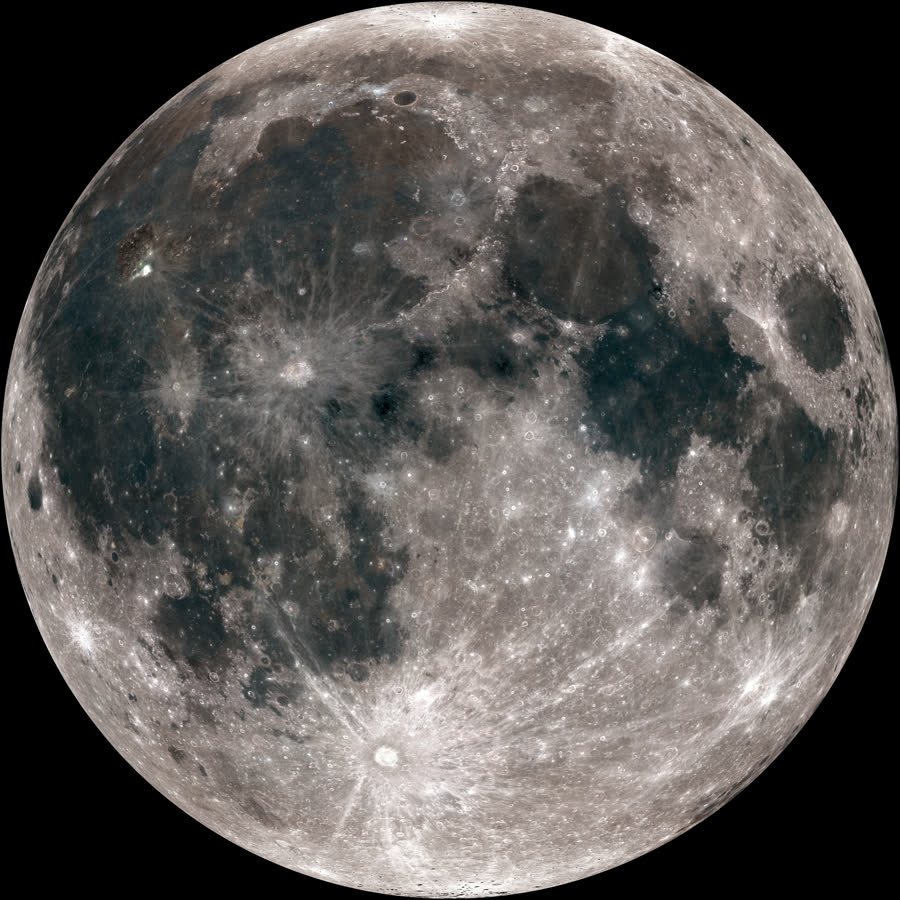
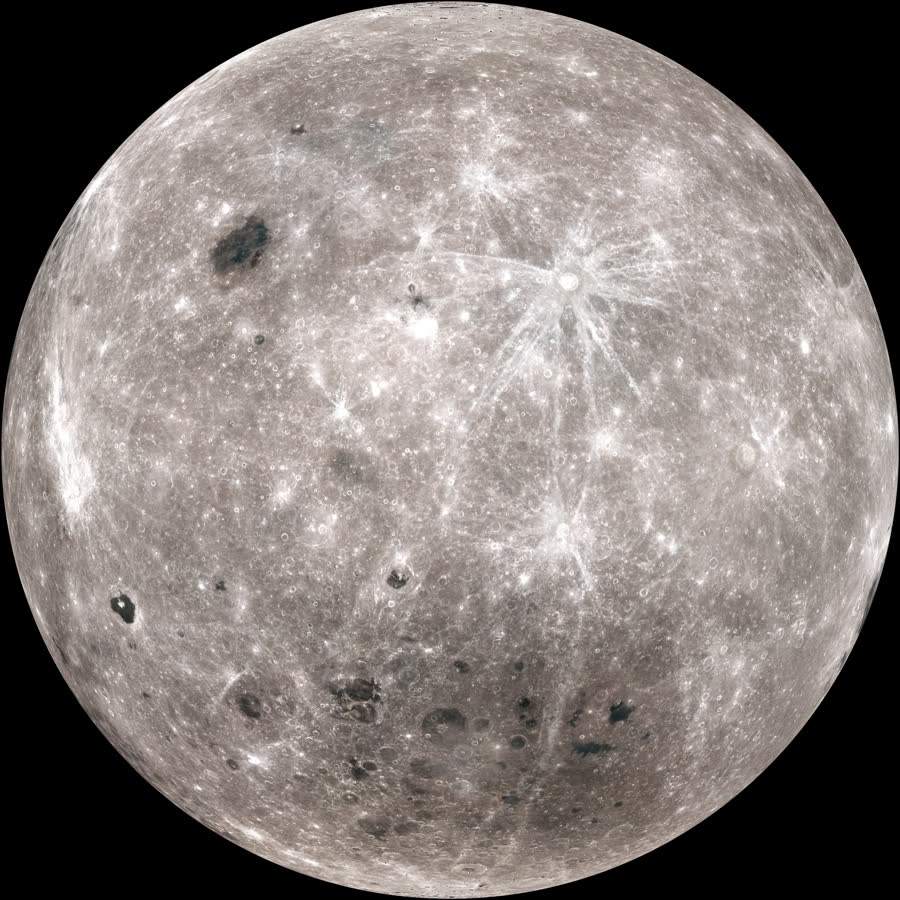
- No light of its own. The Moon shines only with reflected sunlight, and it reflects just 11 to 12 percent of what falls on it (NASA's albedo figures): about as dark as worn asphalt, yet the brightest thing in our night sky.
- One face. It turns once in 27.3 days, the same time it takes to orbit Earth, so the same side always faces us. A slight wobble (libration) lets us see about 59 percent of the surface over time. The far side is not dark: it gets as much sunlight as the near side; it is only unseen.
- It moves the waters. The Moon is the main driver of ocean tides. The Sun helps too, with a tide-raising force a little under half the Moon's (NOAA), which is why the highest tides come near new and full Moon.
What the tradition saw
Chandra is manas, the mind. Like the Moon, a mind has no light of its own: it shines with what it receives and colours itself with what falls on it. It shows the world one face and keeps another to itself, and it rises and falls like the tides. These are symbols. Studies have not found that the Moon changes how people behave; the tradition uses the Moon to describe the mind.
What the Moon means
In Vedic astrology
In the image of the cosmic person (Brihat Jataka 2.1; BPHS ch. 3), the Moon is the mind (manas). Its significations include:
- The mind and emotions — mood, memory, contentment, the ability to rest.
- The mother and nurturing, and the 4th house of home and inner peace, of which it is the natural significator.
- The public and the people — popularity, being liked, care-giving roles.
- Body associations — fluids, the breast, the left eye, sleep (as classical associations, not medical claims).
- Nature — sattvic, feminine, watery. The Moon is strong in the 4th house (directional strength) and at night.
The Moon's brightness matters. A waxing Moon, and particularly one close to full, is counted a natural benefic; a dark Moon near the new Moon is weaker and counted a malefic by many authorities, with the exact threshold varying from text to text. That is why two people with the Moon in the same sign can have very different Moons.
Because the mind colours everything we experience, Vedic astrologers read a chart from the Moon as well as from the ascendant (Chandra lagna). Transits are judged from the Moon (gochara), including Saturn's well-known seven-and-a-half-year passage over the 12th, 1st and 2nd signs from it, called Sade Sati. The Moon's nakshatra decides the birth dasha, the name syllable, and the core of marriage matching (Ashtakoota).
About moolatrikona: BPHS gives Taurus as both the Moon's exaltation and moolatrikona sign. Different editions and later authorities draw the line differently — some give exaltation up to 3° and moolatrikona from 3° or 4° to 30°, others moolatrikona only from 4° to 20°. Sunyra's engine states which convention it uses.
In Western astrology
Ptolemy (Tetrabiblos I.4) gives the Moon a mainly moistening power, with mild warmth borrowed from the Sun. In Hellenistic astrology the Moon leads the nocturnal sect with Venus and Mars, and in a night chart it is an especially important indicator of fortune and the body. Lilly (Christian Astrology, Book I, chapter on the Moon) describes the well-placed Moon as gentle and fond of novelty and travel, the afflicted Moon as unsettled and easily discontented.
Modern Western astrology reads the Moon as the emotional self: what you need to feel safe, your instinctive reactions, your relationship with your mother and with your own body, and the habits that carry you when you are tired. Many astrologers say the Sun is who you are becoming and the Moon is who you are when no one is watching.
Strengths
A well-supported Moon gives emotional intelligence: steadiness under pressure, the ability to comfort others, good instincts, a reliable memory and a gift for making places feel like home. People with a strong Moon tend to be popular in a quiet way — trusted rather than admired.
Challenges
The Moon changes constantly, and so can the mind it describes. Afflictions — the Moon with Rahu or Ketu, under Saturn's heavy aspect, debilitated in Scorpio, or very dark — are traditionally read as a more sensitive or restless mind: worry, changeable moods, or a need for more reassurance than others notice. A Moon with no planets on either side of it (Kemadruma) is classically a lonely configuration, though BPHS and later texts list many conditions that cancel it. As always, the full chart and the person's own choices decide far more than any single factor.
In relationships
The Moon shows how you love when you are not performing: the comfort you look for, the care you give, how you behave when you are hurt. In Vedic marriage matching, the two Moons are compared directly — all eight kootas of Ashtakoota are derived from the Moon's sign and nakshatra. In Western synastry, Moon contacts (especially Sun–Moon and Moon–Venus) are read as signs of ease and familiarity. A Moon in fire signs tends to need enthusiasm; in earth, reliability; in air, conversation; in water, closeness.
In career and work
The Moon favours work with people and care: hospitality, nursing and care professions, teaching young children, food, public-facing roles, anything that involves the public mood. Because the Moon fluctuates, a strong lunar emphasis sometimes shows a career with several phases rather than one straight line.
Health as wellbeing
Traditionally the Moon is linked to the body's fluids, to sleep and to the mind's equilibrium. Read as wellbeing, the Moon asks for rest, regular meals, emotional honesty and enough time near water or open sky. If mood or sleep is a real struggle, that is a conversation for a doctor or counsellor, not for a chart.
How the Moon changes by placement
- By sign. Exalted in Taurus, the Moon tends to be calm and contented. In Cancer, its own sign, it is nurturing and protective. Debilitated in Scorpio, feelings run deep and private, and trust is earned slowly. In fire signs the mind is quick and warm; in air signs, curious and social.
- By house. In the 4th (its directional strength) the Moon seeks a settled home; in the 10th it brings public life; in the 6th, 8th or 12th it can make the mind more inward or worried, and also more perceptive.
- By aspect and conjunction. Jupiter in a kendra (1st, 4th, 7th or 10th) from the Moon forms the classic Gajakesari yoga, a combination for wisdom and good name. Mars with the Moon (Chandra-Mangala yoga) gives drive and resourcefulness. Saturn with the Moon matures the mind, sometimes through early responsibility.
- By nakshatra. Each nakshatra gives the Moon a different temperament; this is the most detailed layer of lunar reading in Vedic astrology. See our nakshatra guides.
The Moon's dasha (Vimshottari)
The Moon's mahadasha lasts ten years. It follows the Sun's six years and precedes Mars's seven. Those born with the Moon in Rohini, Hasta or Shravana begin life in the Moon's own dasha. Moon periods often bring home, family, mother, emotional life and public connection to the foreground: moving house, starting a family, finding a community. Their tone depends on the Moon's brightness, sign, house and lordship.
The Vimshottari system itself is built on the Moon. The dasha at birth is decided by the Moon's nakshatra, and the balance remaining is calculated from how far the Moon has travelled through it. A small error in birth time changes this balance, which is one reason accurate birth data matters.
Vedic and Western views compared
Both traditions read the Moon as the emotional and instinctive self, and both agree on its rulership of Cancer, exaltation in Taurus and fall in Scorpio. The difference is emphasis. Vedic astrology often treats the Moon as at least as important as the ascendant: horoscopes are cast from it, dashas start from it, compatibility is matched on it, and daily "rashifal" horoscopes are written by Moon sign. Western popular astrology leads with the Sun sign, though serious Western astrologers have always given the Moon equal weight.
Traditional remedies
The tradition associates the Moon with Monday fasts or simple meals, worship of Shiva or the Divine Mother, offering water or milk, and charity in white (rice, milk, white cloth). Respect and care for one's mother is described as a remedy in itself. Pearl is the Moon's traditional gem; as with every gem, traditional practice is to recommend it only after the whole chart has been read. These are devotional practices, offered as such, and they are not a substitute for care when the mind is struggling.
FAQ
Why do Vedic horoscopes use the Moon sign instead of the Sun sign? Because the Moon, as the mind, colours lived experience, and because transits, dashas and matching are all calculated from it.
What is Sade Sati? Saturn's transit over the 12th, 1st and 2nd signs from the natal Moon, about seven and a half years. It is traditionally a period of maturing responsibility, not a curse. See our article on Saturn.
Is the Moon a benefic? A bright, waxing Moon is a natural benefic; a dark Moon near new Moon is counted a malefic by many texts.
How long is the Moon dasha? Ten years in the Vimshottari system.
Why does the Moon get no "enemies" in BPHS? BPHS ch. 3 lists only the Sun and Mercury as its friends and every other planet as neutral. Astrologers read this as the Moon's receptive, reflecting nature.
Does the Moon go retrograde? No. The Sun and Moon never appear retrograde.
Sources
- Brihat Parashara Hora Shastra, ch. 3 (Santhanam)
- Brihat Jataka of Varahamihira, ch. 2
- Phaladeepika of Mantreswara, ch. 2
- Mahabharata, Shalya Parva (Prabhasa and Soma)
- Vishnu Purana 4.6; Bhagavata Purana 8.8, 9.14
- Rigveda, Mandala 9
- Ptolemy, Tetrabiblos I.4, I.17, I.19
- William Lilly, Christian Astrology (1647), Book I
- D. R. Williams, NASA NSSDCA Moon Fact Sheet, 2025
- NOAA National Ocean Service, Tides and Water Levels: What Causes Tides?
- Images: NASA (via Wikimedia Commons), public domain
Written by Sunyra Editorial. Astrology is a tradition of interpretation; read this as guidance, not a forecast. Disclaimer.
Last reviewed