
On this page
In short: Venus is love, beauty, pleasure, art and the things we value. In Vedic astrology Shukra is also the guru of the asuras — a brilliant teacher who knows the secret of bringing the dead back to life — and the significator of marriage, comfort and refinement. In Western astrology Venus is attraction, harmony and taste. It asks what you love and how you receive it. Its Vimshottari dasha lasts twenty years, the longest of all.
At a glance
| Vedic (sidereal) | Western (tropical) | |
|---|---|---|
| Names | Shukra, Shukracharya, Bhargava, Kavi, Ushanas, Daitya-guru | Venus, Aphrodite |
| Rules | Vrishabha (Taurus), Tula (Libra) | Taurus, Libra |
| Exaltation | Meena (Pisces), deepest at 27° | Pisces (27°) |
| Debilitation / fall | Kanya (Virgo), deepest at 27° | Virgo |
| Moolatrikona | Libra 0°–15° (BPHS) | — |
| Detriment | — | Aries, Scorpio |
| Nakshatras ruled | Bharani, Purva Phalguni, Purva Ashadha | — |
| Vimshottari dasha | 20 years | — |
| Day | Friday (Shukravara) | Friday (Vendredi, Viernes) |
| Natural friends (BPHS) | Mercury, Saturn | — |
| Natural enemies (BPHS) | Sun, Moon (Mars, Jupiter neutral) | — |
| Gem / colour (traditional) | Diamond; white | — |
The story of Shukracharya
The Sanskrit word shukra means "bright, clear" — fitting for the brightest planet in the sky. Shukra is a sage of the line of Bhrigu (hence Bhargava), known in the Rigveda as Ushanas Kavya, "Ushanas the poet". In the epics and Puranas he is the acharya — the teacher and priest — of the asuras, the rivals of the gods, just as Brihaspati (Jupiter) is the teacher of the gods.
Shukra's power was a secret no one else possessed: the Mrita-sanjivani vidya, the knowledge that restores the dead to life, which Puranic tellings say he won from Shiva through long and severe austerity. Because of it, the asuras who fell in battle rose again. The Mahabharata's Adi Parva tells how the gods sent Kacha, Brihaspati's son, to learn the secret as Shukra's student, and how Shukra's daughter Devayani loved him. When the asuras burned Kacha and dissolved his ashes in Shukra's wine, Shukra had to teach him the knowledge while Kacha lay inside him, so that Kacha could emerge and revive his teacher. Afterwards Shukra, horrified by what wine had made him do, declared that a Brahmin who drank it would lose his merit. Devayani asked Kacha to marry her; he refused, because she was now like a sister to him, having both been "born" from the same teacher. Her later marriage to King Yayati, and the rivalry with the princess Sharmishtha, is one of the great love stories of the epic — passionate, jealous and full of consequence. Venus's stories are never only about sweetness.
Shukra also appears in the story of Vamana, the dwarf avatara of Vishnu (Bhagavata Purana 8.19–8.20). When the dwarf asked King Bali, Shukra's disciple, for three steps of land, Shukra recognised Vishnu and warned Bali not to give it. Bali, who would not break his word, gave anyway, and Shukra cursed him for disobedience. A popular later telling, not found in the Bhagavata's own account, adds that Shukra shrank himself into the spout of the water vessel to stop the gift being sealed, and that Vamana cleared the spout with a blade of grass and pierced one of his eyes — which is why Shukra is sometimes called one-eyed. BPHS ch. 2 associates Venus with the Parashurama avatara.
In Greek myth, Aphrodite is born from the sea foam that gathered around the severed parts of the sky-god Ouranos (Hesiod, Theogony) and comes ashore at Cyprus. She is the goddess of desire and beauty, married to Hephaestus and in love with Ares. The Romans identified her with Venus, mother of Aeneas and so of the Roman people.
The real Venus
Venus is the second planet from the Sun, almost Earth's twin in size (12,104 km across), orbiting at about 108 million km (0.72 AU) in 225 days. It turns very slowly backwards on its axis: its rotation takes 243 Earth days, longer than its year. A crushing atmosphere of carbon dioxide and clouds of sulphuric acid make its surface the hottest in the solar system, around 464 °C — hotter than Mercury's. It has no moons.
From Earth, Venus is the brightest object after the Sun and Moon, appearing as the "morning star" or "evening star" and never more than about 47° from the Sun. It turns retrograde roughly every 19 months for about six weeks. Five of its cycles with the Sun take almost exactly eight years, and the five points where it meets the Sun trace a near-perfect five-pointed star around the zodiac — a pattern astrologers have watched since Babylonian times.
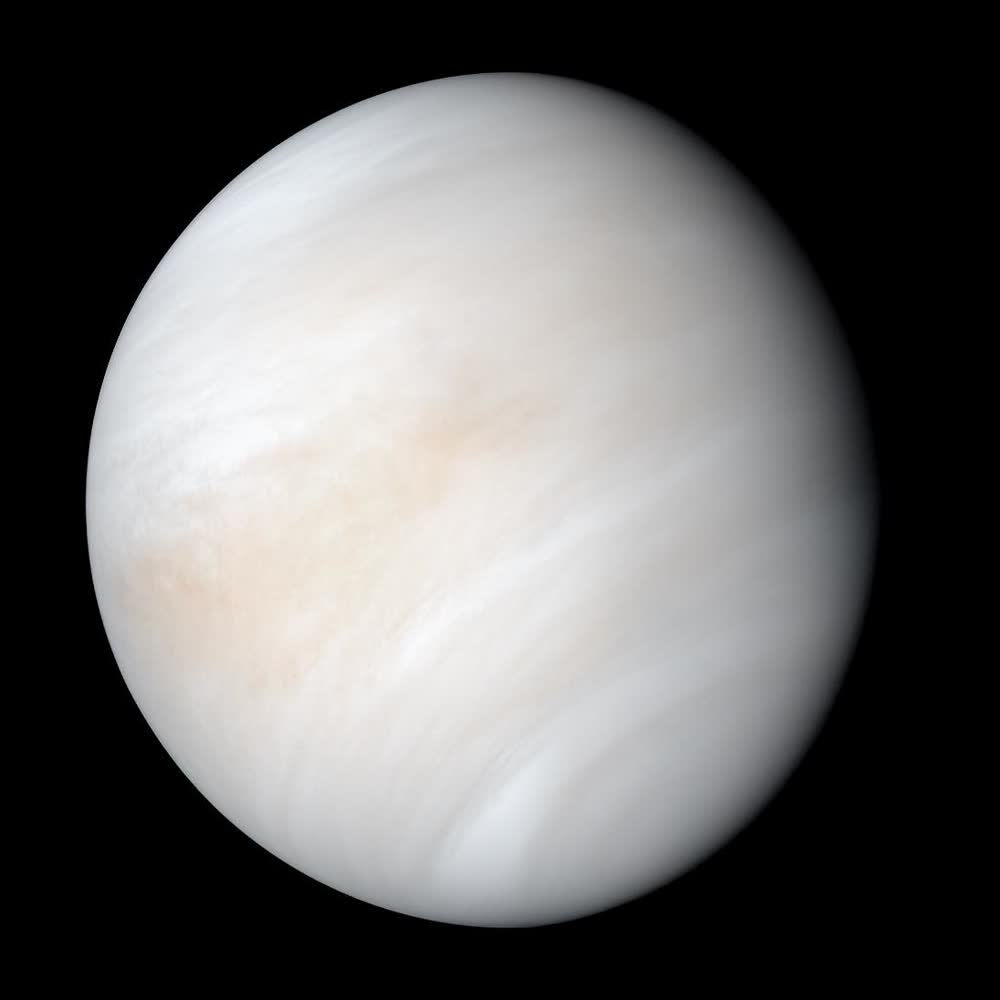
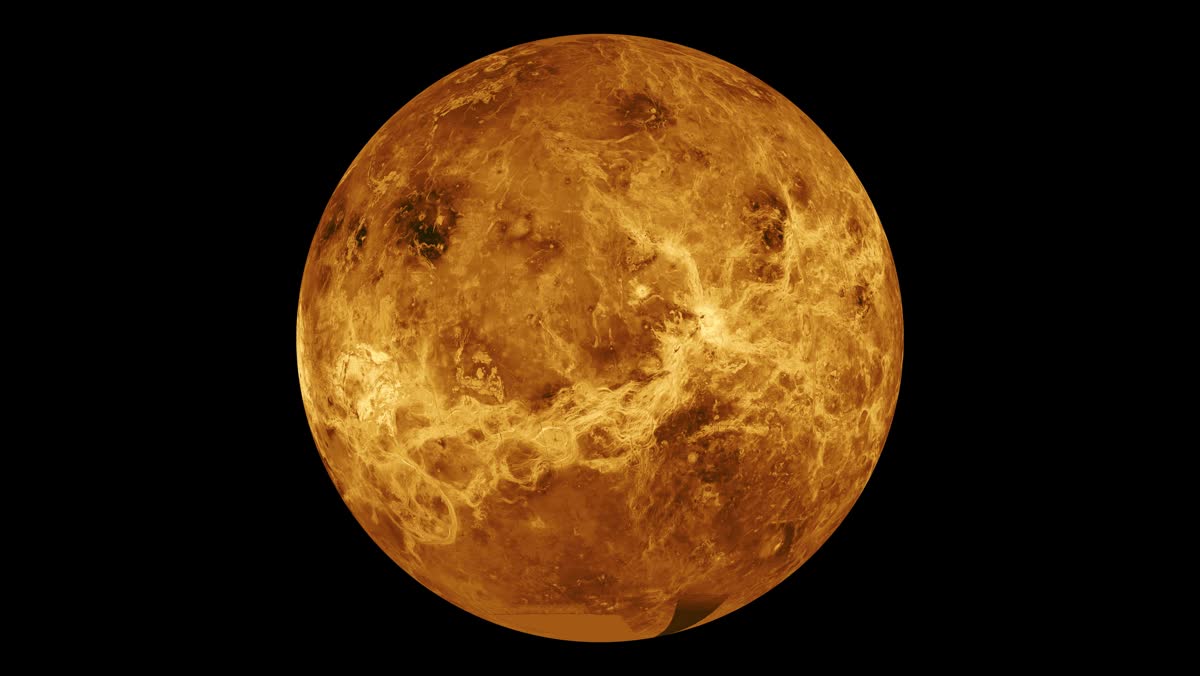
- The brightest planet. At its best Venus reaches magnitude −4.8 (NASA); only the Sun and the Moon outshine it.
- Veiled. Clouds of sulphuric acid reflect about three-quarters of the sunlight that reaches them and hide the ground completely. Its surface was mapped by Magellan's radar from 1990 to 1994.
- Hottest surface of any planet, about 464 °C on average, under an atmosphere 92 times as heavy as Earth's: like being some 900 m under the sea.
- It turns the other way. Venus rotates backwards once in 243 Earth days, longer than its 225-day year. Seen from its surface, the Sun would rise in the west.
What the tradition saw
Shukra is beauty, love, art, pleasure and refinement, and also Shukracharya, the wise teacher of the asuras who knew the secret of reviving life. The real Venus is the most beautiful light in the evening sky, and behind its veil lies the most intense surface of any planet. It also does things the other way round. Beauty, it suggests, is rarely only on the surface.
What Venus means
In Vedic astrology
In the cosmic person (Brihat Jataka 2.1; BPHS ch. 3) Venus is desire or potency (kama, virya), and with Jupiter it is a minister of the planetary court. Its significations include:
- Love and marriage — Venus is the natural significator of the 7th house and of the spouse, especially in a man's chart in classical texts; today it is read for every relationship.
- Beauty and the arts — music, dance, poetry, design, perfume, fashion, cosmetics.
- Comfort and pleasure — vehicles, fine clothes, jewellery, a pleasant home, sensual enjoyment.
- Wealth and prosperity — especially the kind that makes life gracious.
- Diplomacy and grace — charm, courtesy and the art of agreement.
- Body associations — the reproductive system, the kidneys and the face, as classical associations rather than medical claims.
- Nature — rajasic, feminine, watery, a natural benefic. Strong in the 4th house (directional strength, shared with the Moon).
In Western astrology
Ptolemy (Tetrabiblos I.4) says Venus is temperate, warming moderately and especially moistening; in I.5 she is beneficent, the "lesser benefic" after Jupiter. In Hellenistic astrology Venus belongs to the nocturnal sect, at her best in a night chart. Lilly (Christian Astrology, Book I, chapter on Venus) describes the well-dignified Venus as quiet, cheerful and peaceable, fond of music and merriment, and the ill-dignified as given to excess and idleness.
Modern Western astrology reads Venus as how we love and what we value: our taste, our pleasures, what attracts us, our relationship to money and to our own worth, and the way we create harmony with others.
Strengths
A strong Venus gives charm, kindness, artistic gifts, a sense of beauty and the ability to make others feel at ease. It favours affection, good company, comfort and the capacity to enjoy life without guilt. Venus is the planet of reconciliation: people with a well-placed Venus often bring peace into a room.
Challenges
Venus's shadow is indulgence and avoidance: preferring pleasure to effort, peace at any price, or valuing appearances over substance. Debilitated in Virgo, Venus can become critical in love, never quite satisfied, or self-effacing — the gift there is discernment and devoted service. Afflicted by malefics, Venus may describe complicated relationships or a restless search for satisfaction. As always, the full chart decides.
In relationships
This is Venus's home ground. Its sign shows how you love and what draws you; its house shows where in life love and pleasure gather; its aspects show what supports or complicates them. In Vedic astrology Venus is read with the 7th house, its lord and the D9 (Navamsa) chart for marriage. In Western synastry, one person's Venus touching the other's Sun, Moon or Mars is a classic sign of attraction.
In career and work
Venus favours the arts and entertainment, design, fashion and beauty, hospitality, luxury goods, jewellery, perfume, diplomacy and public relations, and any work involving relationships, aesthetics or pleasure. A Venus connected to the 10th house often brings work that makes life more beautiful.
Health as wellbeing
Traditionally Venus is linked with the reproductive system, the kidneys, complexion and overall vitality through pleasure and rest. As wellbeing, Venus asks for balance — beauty, music, good company and real rest, without the excess that turns pleasure into its opposite. These are traditional associations, not medical guidance.
How Venus changes by placement
- By sign. Exalted in Pisces, Venus is devoted, compassionate and romantic, love as something almost spiritual. In Taurus it is sensual and loyal; in Libra, refined and fair-minded. Debilitated in Virgo, it serves and analyses love. In Mars's signs it is passionate and direct.
- By house. Venus in the 4th has directional strength — a lovely home, comforts and vehicles. In the 7th it emphasises partnership. In the 12th (a placement classical texts consider surprisingly good for Venus) it is linked with private pleasures and generosity.
- By aspect and conjunction. Venus in a kendra in its own or exaltation sign forms Malavya yoga, one of the five Pancha Mahapurusha yogas. Venus with Mars blends desire and action; with Saturn it gives loyalty and sometimes delay in love; with Jupiter it combines the two benefics, which classical texts treat with interest because they are natural enemies.
- By nakshatra. Venus's nakshatras — Bharani (bearing and creation), Purva Phalguni (pleasure and rest) and Purva Ashadha (invincible conviction) — show Venus as creative force, as joy and as inner strength.
The Venus dasha (Vimshottari)
The Venus mahadasha lasts twenty years, the longest in the Vimshottari system. It follows Ketu's seven years and precedes the Sun's six. Those born with the Moon in Bharani, Purva Phalguni or Purva Ashadha begin life in Venus's dasha. Venus periods often bring relationships, marriage, comfort, property, vehicles, the arts and a more social life. With twenty years to unfold, the sub-periods (antardashas) matter a great deal in describing how the chapter changes.
Venus's retrograde periods and its transits over the natal Sun, Moon and Venus are watched in Western astrology; in Vedic practice, Venus's transit through the signs from the Moon is part of standard gochara analysis.
Vedic and Western views compared
The traditions agree on Venus's core: love, beauty, pleasure; rulership of Taurus and Libra; exaltation in Pisces and fall in Virgo. Vedic astrology adds the asura-guru story, which gives Venus a depth of knowledge and diplomacy beyond romance, and treats it as significator of vehicles and comforts. Western astrology emphasises Venus as values and self-worth, and the eight-year Venus cycle has become a popular way to read relationship patterns.
Traditional remedies
For Venus the tradition recommends respect toward women, gifts of white items (rice, sugar, white cloth) on Fridays, worship of Lakshmi or the Goddess, and recitation of the Shukra mantra. Cultivating the arts and treating partners with care are themselves described as remedies. Diamond (or a white substitute) is the traditional gem, recommended only after a full reading. These are traditional practices, not guarantees.
FAQ
Why is the Venus dasha twenty years? The Vimshottari scheme assigns fixed lengths to each planet, totalling 120 years; Venus has the longest share. BPHS gives the scheme but not an explanation of the numbers.
Is Venus retrograde a bad time for love? Popular Western astrology treats it as a time to revisit rather than begin. Classical Vedic texts do not treat retrograde Venus as harmful.
Why are Venus and the Sun enemies in Vedic astrology? BPHS ch. 3 lists the Sun and Moon as Venus's natural enemies. Astrologers read this as the tension between self-assertion (Sun) and partnership (Venus).
How long is the Venus dasha? Twenty years in the Vimshottari system.
Is Venus in Virgo always difficult? No. Debility can be cancelled (neecha bhanga), and the placement often gives discernment and devotion.
Sources
- Brihat Parashara Hora Shastra, ch. 2–3 (Santhanam)
- Brihat Jataka of Varahamihira, ch. 2
- Phaladeepika of Mantreswara, ch. 2
- Mahabharata, Adi Parva (Kacha, Devayani and Yayati)
- Bhagavata Purana 8.19–8.20 (Vamana and Bali)
- Hesiod, Theogony (birth of Aphrodite)
- Ptolemy, Tetrabiblos I.4, I.5, I.17, I.19
- William Lilly, Christian Astrology (1647), Book I
- D. R. Williams, NASA NSSDCA Venus Fact Sheet, 2025
- Images: NASA (via Wikimedia Commons), public domain
Written by Sunyra Editorial. Astrology is a tradition of interpretation; read this as guidance, not a forecast. Disclaimer.
Last reviewed