
On this page
In short: Rahu is not a planet but a point — where the Moon's orbit crosses the Sun's path going north. Vedic astrology counts it among the nine grahas, "seizers", because it seizes the Sun and Moon in eclipses. Rahu is hunger: ambition, fascination, the foreign and the new, the desire for more. It can lift a person far beyond their origins, and it can leave them never quite satisfied. Western astrology reads the same point, the North Node, as the direction of growth. Rahu's Vimshottari dasha lasts eighteen years.
At a glance
| Vedic (sidereal) | Western (tropical) | |
|---|---|---|
| Names | Rahu, Svarbhanu, Saimhikeya, Tamas | North Node, Caput Draconis, Dragon's Head |
| What it is | Ascending lunar node | Ascending lunar node |
| Motion | Always retrograde (mean node) | Mean or true node |
| Exaltation | Disputed: Taurus or Gemini | Gemini (medieval) |
| Debilitation | Disputed: Scorpio or Sagittarius | Sagittarius (medieval) |
| Own sign | Disputed: Aquarius (co-ruler) or Virgo | — |
| Nakshatras ruled | Ardra, Swati, Shatabhisha | — |
| Vimshottari dasha | 18 years | — |
| Lal Kitab "pakka ghar" | 12th house | — |
| Gem (traditional) | Hessonite (gomed) | — |
The story of Rahu
The oldest form of the story is in the Rigveda. Hymn 5.40 tells how Svarbhanu, an asura, "pierced the Sun with darkness", and how the sage Atri found the hidden Sun again and restored its light. Svarbhanu is the first eclipse demon of Indian literature.
The full myth comes with the churning of the Ocean of Milk, told in the Mahabharata's Adi Parva, the Bhagavata Purana (8.9) and the Vishnu Purana (1.9). The gods and asuras together churned the ocean to obtain amrita, the nectar of immortality. When it appeared, Vishnu took the form of Mohini, an enchanting woman, and distributed it — to the gods only. One asura, Svarbhanu, the son of Simhika (hence Saimhikeya), disguised himself and sat in the line of gods between the Sun and the Moon. He had just swallowed the nectar when the Sun and Moon recognised him and called out. Vishnu struck off his head with the Sudarshana discus. But the nectar had already reached his throat: the head, Rahu, and the body, Ketu, both became immortal. Ever since, the story says, Rahu pursues the Sun and Moon and swallows them at eclipse — and since he has no body, a popular explanation adds, they soon slip out again through his throat.
What is less often told is that classical Indian astronomers knew perfectly well what an eclipse is. Varahamihira, in the Brihat Samhita (ch. 5), explains that a lunar eclipse happens when the Moon enters the Earth's shadow and a solar eclipse when the Moon covers the Sun, and he sets the demon aside as the cause while keeping Rahu's place in the tradition. The myth and the mathematics lived together. BPHS ch. 2 associates Rahu with Vishnu's Varaha (boar) avatara.
The Western name — the Dragon's Head — came into European astrology through Persian and Arabic sources, which inherited the image of the eclipse dragon. William Lilly (Christian Astrology, Book I) describes the Head of the Dragon as masculine and of the nature of Jupiter and Venus — that is, beneficial — and the Tail as of the nature of Saturn and Mars.
The real Rahu
Rahu has no body at all. The Moon's orbit is tilted about 5.1° to the ecliptic, the Sun's apparent path. The two points where the orbits cross are the lunar nodes. Rahu is the ascending (north) node, where the Moon crosses going north; Ketu is the descending (south) node, always exactly opposite. Eclipses can only happen when a new or full Moon falls near a node, which is why eclipses come in "seasons" about every 173 days.
The nodes move backwards through the zodiac, completing a full circle in about 18.6 years and spending about eighteen months in each sign. Astrologers use either the mean node (a smoothed average, always retrograde) or the true node (the actual osculating point, which wobbles and occasionally pauses or briefly moves forward). Vedic practice most often uses the mean node; many Western astrologers prefer the true node. Sunyra shows both and says which is in use.
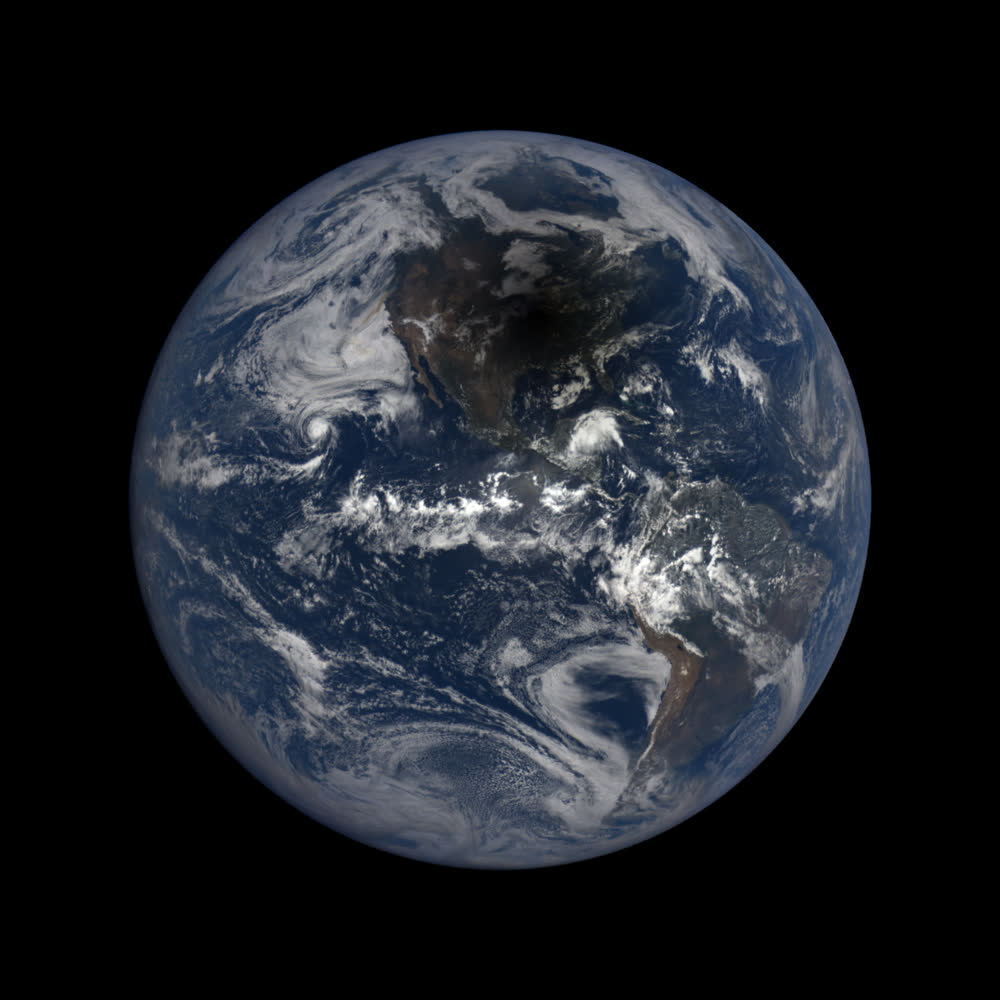
There is nothing at Rahu to photograph. What you can photograph is what happens there: the dark patch over North America above is the Moon's shadow during the total solar eclipse of 21 August 2017, seen by NASA's camera on the DSCOVR spacecraft.
What the tradition saw
In the story, Rahu is the head that drank the nectar and keeps swallowing the Sun. The real Rahu is a point in space, without mass or light, and yet when the Sun and Moon line up there, the day goes dark. A point with no body that can cover the brightest light: the tradition's picture of desire, obsession and illusion fits it well. Rahu is not a thing; it is what a shadow can do.
What Rahu means
In Vedic astrology
Rahu is a chhaya graha, a shadow planet. It has no body, so it acts through the sign it occupies, the planets with it, and the lord of that sign and its nakshatra. A widely repeated traditional maxim says "Shanivat Rahu" — Rahu behaves like Saturn — and "Kujavat Ketu" — Ketu like Mars. Its common significations:
- Ambition and appetite — the drive to acquire, achieve, rise and experience. Rahu magnifies whatever it touches.
- The foreign and unconventional — foreign lands and cultures, outsiders, taboo-breaking, new technology, the unfamiliar.
- Illusion and obsession — smoke, mirrors, intoxicants, fame, fixation, and the restlessness of never-enough.
- Sudden change — unexpected rises and falls; Rahu's results often arrive quickly.
- Nature — a natural malefic, tamasic, associated with smoke and poison in classical texts.
Dignities are disputed. BPHS editions and later authors disagree on the nodes' exaltation and own signs. One school gives Rahu exaltation in Taurus and debilitation in Scorpio; another gives Gemini and Sagittarius. Some give Rahu co-rulership of Aquarius with Saturn; others give it Virgo. Sunyra's engine names the convention it uses, and our readings do not lean heavily on node dignity.
Aspects. Many astrologers give Rahu Jupiter-like aspects on the 5th and 9th from itself, as well as the 7th; others use only the 7th. This too is a matter of school.
KP astrology. In Krishnamurti Paddhati (KP Readers), the nodes are treated as agents: Rahu gives the results of the planets it is conjoined with or aspected by, of its sign lord and of its nakshatra lord — a clear, testable rule that many Vedic astrologers outside KP also use.
Lal Kitab. In Lal Kitab, Rahu's permanent house (pakka ghar) is the 12th, and its remedies (often involving barley, coconut or flowing water) are specific to the house it occupies. Lal Kitab's rules are its own system and should not be mixed casually with Parashari ones.
Kaal Sarp yoga. A chart in which all seven planets fall on one side of the Rahu–Ketu axis is popularly called Kaal Sarp yoga. It does not appear in BPHS or the major classical texts; it is a later doctrine, and astrologers disagree about whether it matters at all. Sunyra will describe it honestly as a debated idea and never sell fear around it.
In Western astrology
Medieval Western astrology treated the North Node as benefic (Jupiter–Venus in nature) and the South Node as malefic. Since the twentieth century, especially after Martin Schulman's Karmic Astrology (1975) and the evolutionary astrology of Jeffrey Wolf Green, the nodes are read as a soul's journey: the South Node shows the familiar habits and gifts we bring with us, and the North Node shows the less comfortable direction in which we grow. The nodal return, roughly every 18.6 years (around ages 18–19, 37, 56 and 74), is often read as a turning point of purpose.
Strengths
Rahu gives boldness, originality, worldly drive, the courage to cross borders, and an ability to thrive in the new and unfamiliar. People with a strong Rahu are often innovators, outsiders who change the inside, and people who rise far from where they began. Rahu also gives a sharp instinct for what the world is about to want.
Challenges
Rahu's difficulties are restlessness, dissatisfaction, confusion between wanting and needing, and the pull of shortcuts. It can bring fascination with what is glamorous but hollow, or a sense of being an outsider. A heavily afflicted Rahu is read carefully around anything addictive or deceptive. The classical counsel is not to fear Rahu but to give its hunger a worthy object.
In relationships
Rahu in or connected to the 7th house is traditionally read as an unconventional partnership — someone from another culture, background or country, or a relationship that breaks family expectation. It can bring intense attraction. In Western synastry, one person's planets on the other's North Node often feel fated and growth-giving.
In career and work
Rahu favours technology, media, aviation, foreign trade and work abroad, politics, research into the unknown, pharmaceuticals and chemicals, and any field that is new, disruptive or global. Rahu in the 10th or 11th house is often associated with sudden rises in career and influence.
Health as wellbeing
Rahu is traditionally linked with conditions that are hard to identify, with anxiety, and with toxins and intoxicants. As wellbeing, it asks for clarity: reducing stimulants, keeping a grounded routine and seeking clear answers when something is wrong. These are traditional associations, not medical advice.
How Rahu changes by placement
- By sign. Rahu amplifies the sign it occupies and its lord. In Mercury's and Venus's signs (and Saturn's) it is often considered comfortable; in the Sun's and Moon's it can unsettle identity or emotions.
- By house. Rahu in the 3rd, 6th, 10th and 11th (the upachaya houses) is traditionally considered well placed — its hunger serves effort and competition. In the 1st it gives a magnetic, unconventional identity; in the 4th or 8th it is weighed more carefully.
- By conjunction. Rahu with the Sun or Moon (an "eclipse" combination) is intense and read carefully; with Jupiter it forms Guru-Chandala yoga, unconventional belief; with Venus, unusual pleasures and aesthetics; with Mercury, a technical, clever mind.
- By nakshatra. Rahu's nakshatras — Ardra (storm and renewal), Swati (independence and the wind) and Shatabhisha (healing and secrecy) — show Rahu's restless intelligence at work.
The Rahu dasha (Vimshottari)
The Rahu mahadasha lasts eighteen years. It follows Mars's seven years and precedes Jupiter's sixteen. Those born with the Moon in Ardra, Swati or Shatabhisha begin life in Rahu's dasha. Rahu periods are often dramatic: foreign travel or migration, new careers, rapid rises, unusual relationships, technological or unconventional work, and a strong drive for recognition. Because Rahu acts through its dispositors, the same Rahu period can feel very different in two charts. Rahu's transit over natal planets is also watched, especially near eclipses.
Vedic and Western views compared
Both traditions read the north node as a point of appetite and direction. The Vedic tradition gives Rahu full status as a graha with its own dasha and nakshatras, and generally treats it as a malefic that magnifies. Medieval Western astrology considered it benefic; modern Western astrology reads it as the path of growth rather than a malefic. Vedic texts disagree on its dignities; Western texts mostly use the medieval Gemini/Sagittarius scheme or none.
Traditional remedies
For Rahu the tradition recommends worship of Durga or Bhairava, recitation of the Rahu mantra, charity of black sesame, mustard or blankets, especially on Saturdays, and rites at Rahu temples such as Thirunageswaram and Srikalahasti. Lal Kitab gives house-specific remedies. Hessonite (gomed) is the traditional gem, recommended only after a full chart reading. These are traditional practices, not guarantees.
FAQ
Is Rahu a real planet? No. It is a mathematical point, the Moon's ascending node, but its effects are read as a graha in Vedic astrology.
Why does Rahu always move backwards? The nodes regress because of the Sun's gravitational pull on the Moon's tilted orbit, completing a circle in about 18.6 years.
What is Rahu kaal? A daily period of roughly an eighth of daylight, different on each weekday, traditionally avoided for new beginnings. It is not linked to the actual position of the node.
Is Kaal Sarp yoga in the classical texts? No. It is a later doctrine, and astrologers disagree on its significance.
How long is the Rahu dasha? Eighteen years in the Vimshottari system.
Sources
- Rigveda 5.40 (Svarbhanu)
- Mahabharata, Adi Parva (churning of the ocean)
- Bhagavata Purana 8.9; Vishnu Purana 1.9
- Varahamihira, Brihat Samhita ch. 5 (Rahu-chara)
- Brihat Parashara Hora Shastra, ch. 2–3 (Santhanam)
- K. S. Krishnamurti, KP Readers
- Lal Kitab (1939–1952 editions)
- William Lilly, Christian Astrology (1647), Book I
- Martin Schulman, Karmic Astrology: The Moon's Nodes and Reincarnation (1975)
- D. R. Williams, NASA NSSDCA Moon Fact Sheet, 2025
- F. Espenak, NASA GSFC, Eclipses and the Moon's Orbit
- Images: NASA (via Wikimedia Commons), public domain
Written by Sunyra Editorial. Astrology is a tradition of interpretation; read this as guidance, not a forecast. Disclaimer.
Last reviewed